Pathways to Accomplishment in AI-Assisted Knowledge Work
my dissertation · LMU Munich, 2026
Research on generative AI at work has mostly asked one thing: does it make people more productive? People don't judge their work by output alone, though. They also ask whether they could use their abilities, and whether the result feels like their own achievement. When AI takes over parts of a task, those two can come apart.
How does generative AI shape the experience of accomplishment in knowledge work, and what decides whether AI assistance strengthens or diminishes it?
I answer this in three steps. Together they give a theory of accomplishment in AI-assisted work that is grounded in field studies and tested in an experiment. The short version: AI can reduce ownership when it takes over the work, and it can raise attainability when it removes the constraint that puts a good result out of reach. Accomplishment depends on both.
For people who design AI tools, the question then changes from how much can we automate? to which contributions should stay with the person, and which constraints should AI help remove?
1 · explore
How the experience of work changes
Two diary studies, a year apart, follow knowledge workers as they bring ChatGPT into everyday work. Perceived productivity and accomplishment pull apart, and the gap shifts as people adapt. Ownership matters, but it doesn't explain the whole picture.
CHI '24 · CHIWORK '25
2 · situate
What happens in professional practice
UI designers working under time pressure, and technical and non-technical builders prototyping software with vibe coding. AI can shrink a person's own contribution and expand what they can achieve, both at once. That points to attainability as a second ingredient.
CHI '26 · CHI '26
3 · explain
Testing two pathways
An experiment with 497 participants varies how much the AI writes and whether there is a time limit. Ownership and attainability each contribute to accomplishment. AI help costs accomplishment when people could have done the task alone, and supports it when finishing is in doubt.
under review
Papers in the dissertation
in the order the thesis tells the story ↓
CHI '24 · Honolulu
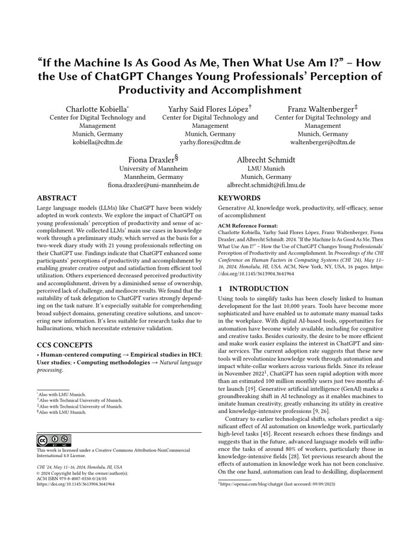
“If the Machine Is As Good As Me, Then What Use Am I?” — How the Use of ChatGPT Changes Young Professionals' Perception of Productivity and Accomplishment
Charlotte Kobiella, Yarhy Said Flores López, Franz Waltenberger, Fiona Draxler, Albrecht Schmidt
In a two-week diary study, 21 young professionals reflected on their ChatGPT use. For some, the tool made work feel more productive and more accomplished. For others, it took away ownership and challenge.
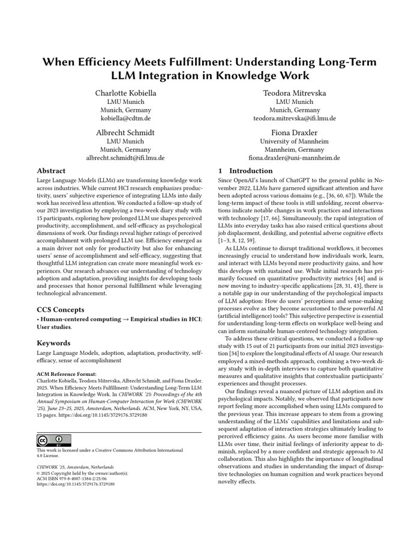
When Efficiency Meets Fulfillment: Understanding Long-Term LLM Integration in Knowledge Work
Charlotte Kobiella, Teodora Mitrevska, Albrecht Schmidt, Fiona Draxler
A follow-up diary study, one year on. With prolonged use, accomplishment ratings went up. Efficiency drove productivity, and it also drove accomplishment and self-efficacy.
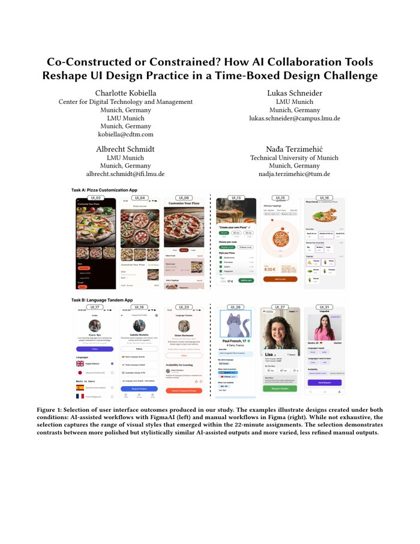
Co-Constructed or Constrained? How AI Collaboration Tools Reshape UI Design Practice in a Time-Boxed Design Challenge
Charlotte Kobiella, Lukas Schneider, Albrecht Schmidt, Nađa Terzimehić
Professional designers tackled a timed design challenge with and without FigmaAI. With AI, design shifted from building up to cutting back. The work got faster, but it felt less fulfilling and less like the designer's own.
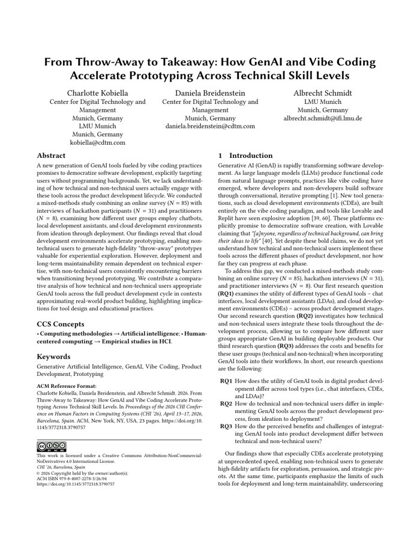
From Throw-Away to Takeaway: How GenAI and Vibe Coding Accelerate Prototyping Across Technical Skill Levels
Charlotte Kobiella, Daniela Breidenstein, Albrecht Schmidt
A survey plus interviews with hackathon participants and practitioners. Vibe coding tools let non-technical people build high-fidelity prototypes. Deployment and long-term maintenance still depend on technical skill.
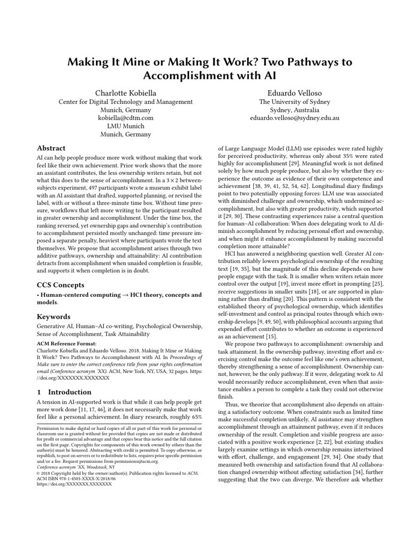
Making It Mine or Making It Work? Two Pathways to Accomplishment with AI
Charlotte Kobiella, Eduardo Velloso
A 3×2 experiment with 497 participants writing with an AI assistant, with and without a time box. Without time pressure, doing more of the writing yourself meant more ownership and accomplishment. Under time pressure, the ranking reversed.
preprint coming soon ✎
Other papers
side quests, also about AI and how work feels
OzCHI '25 · Sydney
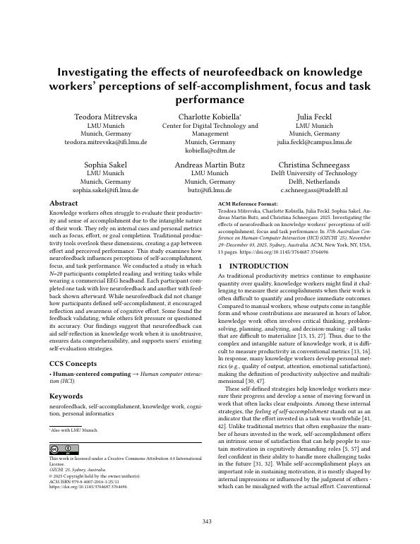
Investigating the Effects of Neurofeedback on Knowledge Workers' Perceptions of Self-Accomplishment, Focus and Task Performance
Teodora Mitrevska, Charlotte Kobiella, Julia Feckl, Sophia Sakel, Andreas Martin Butz, Christina Schneegass
Twenty participants worked while wearing an EEG headband, getting neurofeedback either live or afterwards. The feedback didn't change how they defined accomplishment, but it made them reflect more on their cognitive effort.
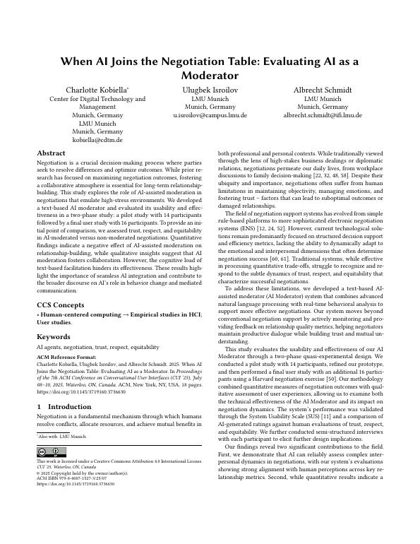
When AI Joins the Negotiation Table: Evaluating AI as a Moderator
Charlotte Kobiella, Ulugbek Isroilov, Albrecht Schmidt
A text-based AI moderator for high-stress negotiations. The numbers showed a negative effect on relationship-building, while participants' accounts suggested it encouraged collaboration. Reading the moderator's text added cognitive load, which got in the way.